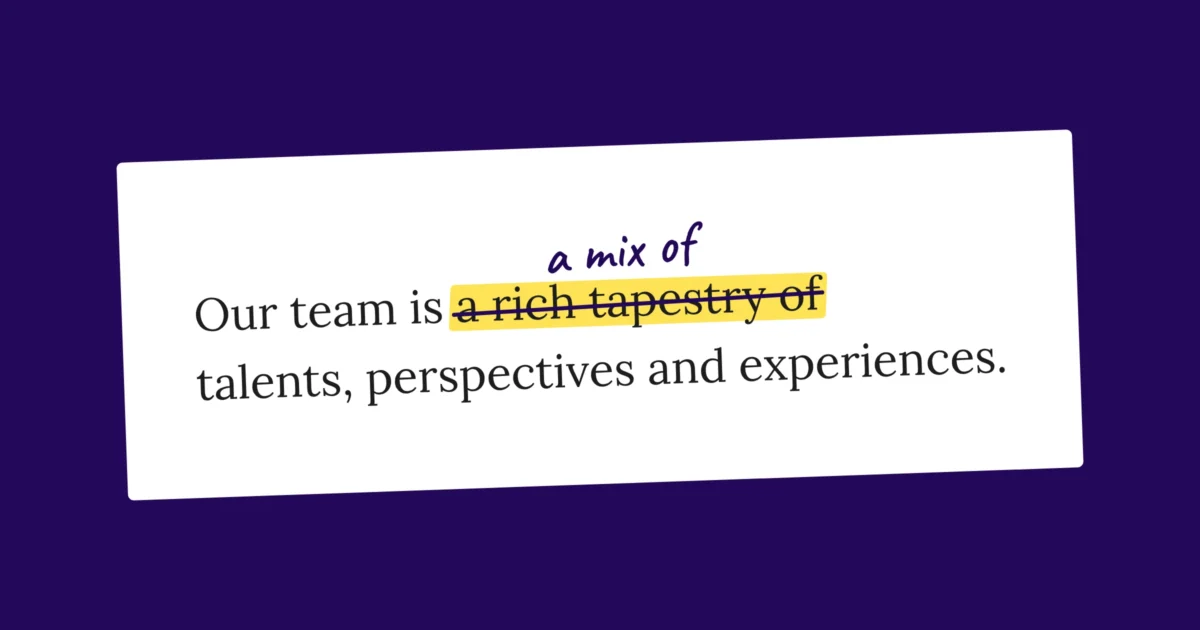
Modern communication in English and use of AI



It’s a familiar situation: you’re writing a message to a friend and your phone suggests the end of your sentence. It makes sense, so you click on the suggestion and complete your message.
Many people already use AI to write in English. It’s a great help, but it can also stop you from learning. This is because when you use AI to write for you, you’re not getting any practice at using the language yourself. So you may not improve as fast as you’d like.
With this in mind, this page looks at the benefits and dangers of English AI – and how to use it as a learning aid.


Table of Contents
Where AI is already writing for you in English
You probably already use artificial intelligence in communication without realising it. Here are some of the places you’ll find it.
Predictive text and suggested replies
Predictive text are those next-word predictions hovering above your WhatsApp message. Or the light grey words that appear ahead of your cursor as you type in Google Docs. They prompt you to complete a word, phrase or sentence with one click.
Many email and chat platforms also provide longer suggested replies. Anything from short phrases like ‘Sounds good!’ or ‘Thanks’ to a complete message. So you can select a pre-written response.
Translators and rewriting tools
Tools like Google Translate are great to convert words, sentences or paragraphs into another language. As well as definitions, specialised dictionaries like Reverso or Linguee give sentence examples. This shows you how language works in context.
Grammar and style checkers like Grammarly or Hemingway are a life-saver for many people. Even first-language speakers. Use them inside your document or as a browser extension to fix grammar, punctuation, complex phrases and tone.
Chatbots and AI email assistants
Using chatbots and email assistants at work, for study or in everyday life is now the norm for many people. Generative AI like ChatGPT, Perplexity or Claude can do almost anything these days. They can suggest essay ideas, act as a conversation partner or even write entire reports. Specialised email assistants like MS Copilot Pro or Superhuman Mail speed up answering emails with helpful templates, text generation and more.
Not sure whether to use AI to write emails? See Should you use AI as your email writer?
What AI does well, and where it can stop you from progressing
While AI has many uses, you need to take care that it doesn’t stop you from learning.
Where AI helps with language learning
Strong writing skills are essential to communicate clearly and efficiently. But grammar, vocabulary, sentence structure or tone can be challenging for learners.
AI helps with all these, with real-time suggestions, corrections and feedback. From spotting errors to suggesting synonyms, AI can help you write better, faster and more confidently.
Where AI hurts
Using AI as a writing aid is great, but relying too much on it can stop you from progressing.
When you use AI to generate text instead of writing yourself, you’re not practising using grammar, vocabulary or organising your ideas in English. You’re also not making mistakes, which is an essential part of learning. So you might get a polished passage, but you won’t improve. Plus, asking AI to summarise documents or messages means you miss out on reading practice and learning new vocabulary in context.
In the long term, this can harm your confidence and performance in situations where you can’t use AI. For example, an English test or in conversation.
Why your own voice still matters
As well as learning the mechanics of writing in English, it’s important to develop your own voice. Here’s why.
People notice generic writing
AI is great at creating perfect, polished sentences. But they tend to all sound the same – generic and full of cliches.
These days, people are very used to seeing common phrases used by AI in writing. So they can tell when you didn’t write something yourself. This can be a negative when it comes to things like applying for a job or posting on LinkedIn. There, generic content can be reported as ‘AI slop’.
Compare these two posts. Which do you think was AI-written?
Post A:

Post B:
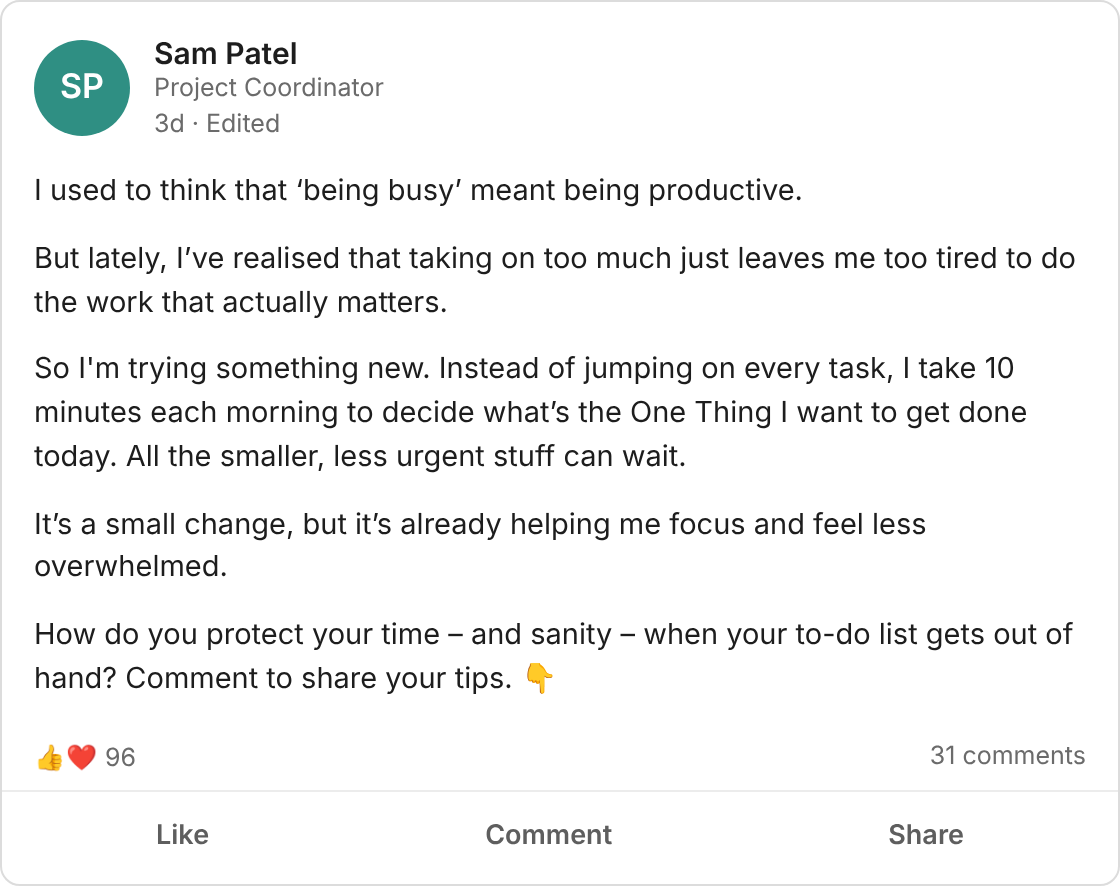
Easy, right? The second post sounds like it was written by a real human.
Developing your own voice turns writing from a mechanical exercise into a form of personal expression. It adds personality and emotion and makes you sound more authentic and relatable. And in a world of AI-generated content, that’s what people increasingly value.
Get more tips to improve your writing skills in English for social media.
Trust is built through personalised communication
The average person sends and receives anything from tens to hundreds of messages every day. That’s a lot to deal with, so it’s normal to want to use AI to help. However, it’s important not to overuse it – or lose the personal touch.
A recent study found that AI helped managers seem more professional. However, medium-to-heavy use for routine communications made them seem less trustworthy. This is because people receiving their messages questioned their authorship, confidence, caring, sincerity and ability.
Communication is all about connection. So messages that convey feeling – thanks, congratulations, apologies, etc, – land better when they sound like you and not a machine.
How to use AI for English learning
Now you know the dangers of relying on AI, let’s look at the right way to use it for learning.
Write first, then check
AI works best as a learning assistant, not a substitute for doing the work yourself. Write your own draft first then use a tool like Claude to act as your editor or critic. Tell it not to rewrite your draft, but instead to highlight your mistakes so you can correct and learn from them.
Tools like Hemingway can also help you write more clearly by suggesting shorter sentences or simpler language.
Whatever you use, reviewing AI feedback can help you understand how grammar and vocabulary work in context. Remember to tell the AI tool your CEFR level so they don’t overwhelm you with more advanced grammar and vocabulary.
Ask AI to explain, not just fix
Real progress happens when you understand why you made a mistake. Ask AI to explain why something isn’t correct – and what to do instead. Over time, you’ll see patterns like repeated grammar or vocabulary mistakes that tell you what to work on. Keep a list of these and note down any new vocabulary, phrases and structures. Then, try to use them in your next piece of writing.
Use it to tailor communication to your audience
Global English makes communication easier for everyone. But, as mentioned, AI can make everyone sound the same. Also, it’s often developed in Western countries, so it may not reflect the slang, humour or cultural sensitivities of others. See Texting etiquette and cross-cultural risks with AI communication for more on this.
What’s considered polite, funny or appropriate varies from country to country. So it’s important to understand your reader and tailor your communication to them. AI can help with this by telling you how to rewrite a message for different audiences. For example, casual, warm and informal and emoji-packed for a close friend. By contrast, formal, polite and structured is better for your boss. You may also want to drop the emojis. See Emoji etiquette and how to use them at work for more on this.
You can also prompt AI to review your writing as if it was a resident of an English-speaking country. This is a great way to learn etiquette and communication norms. When it comes to idioms, you can also ask AI to explain when and how they’re used. This is better than a literal translation, which may not convey subtle, country-specific humor.
Remember, though, that there’s no substitute for lived experience. Always check what AI says against reliable sources – your teacher or an English speaker.
Practise speaking out loud
Of course, using AI for English language learning isn’t just about writing. It’s also great for practising pronunciation, role plays or test questions. Some people prefer this as they’re not worried about making a mistake in front of another person.
For example, after each English Online lesson with a human teacher, you can do AI speaking practice. This lets you build your confidence by practising what you learned in natural, real-life scenarios.
Always check before you send
AI is a great help, but there’s no substitute for your human judgement. Before sharing something you wrote, ask yourself:
- Is the tone right for this person/situation?
- Do I understand every word?
- Does it say everything I want to say?
- Does it sound like me?
If the answer to all of them is ‘yes’, you can hit ‘send’ with confidence!
AI English: A powerful learning aid when used right
AI can help you learn, but you get the best results when you use it as an assistant, guide or editor – not as a substitute for doing the work yourself.
As often as possible, expose yourself to English in real-life contexts such as reading, listening and talking to real people in English. For example, you could read newspaper articles or social media posts, or watch movies and videos. For speaking practice, you could find a partner to practise with in real life or online.
Of course, sometimes you also need a course to add structure and purpose to learning. If so, English Online has a range of courses designed to help you achieve your goals.
Just choose your level – beginner to advanced – and whether you want to join a group or have a private tutor. Either way, there’s a course and schedule to suit you. Right now, you can try group or premium learning activities for free for 7 days.