7 ways to improve writing skills in English for social media



Which social media post would make you stop scrolling?
Post 1:

Or post 2:
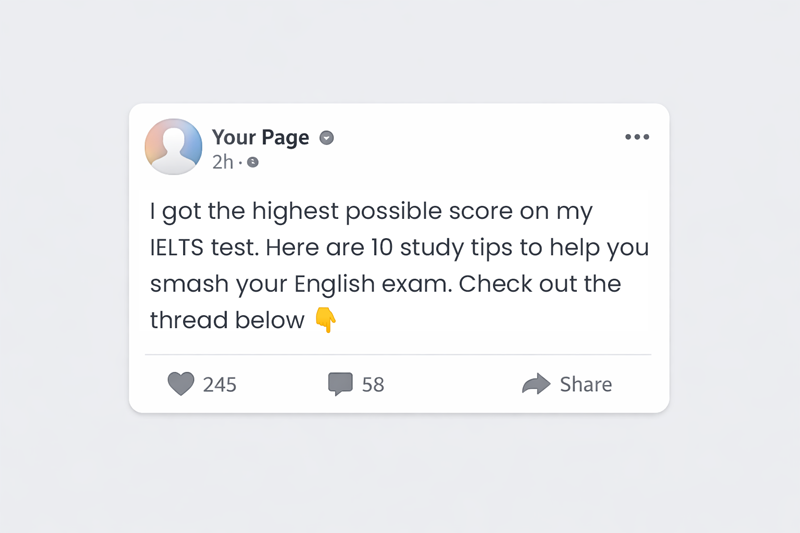
Easy, right? Post 2 uses short, simple sentences, active voice and power verbs (‘smash’). All this indicates you can trust the writer – and their study tips.
Whether you’re communicating for business or pleasure, social media is a great way to do it. But competition for attention online is fierce. So, you need good writing skills to stand out.
In this post, we’ll look at how to improve writing skills in English so you can write scroll-stopping posts.
7 ways to improve writing skills in English for students
If you’re wondering, ‘How can I improve writing skills in English?’ read on for our top tips.
1. Use active voice
Using active verbs and writing in first person (I) makes your writing sound clear, more human and more authentic rather than distant or formal. So instead of ‘This post was created by me,’ try ‘I created this post’. This helps your audience feel more connected to you – and more likely to trust you.
Active voice also uses fewer words, which helps keep your posts short and easy to read.
2. Write in your own voice
Social media is all about authenticity and human connection, so your own voice is your strongest asset. People can tell when a post sounds real, and will appreciate it.
Write the way you speak, using clear, familiar words that make your readers feel you’re a friend, not a brand. Tools like Grammarly or ChatGPT are great for brainstorming ideas, outlining, suggesting alternative phrasing or polishing your grammar. But if you use them to write your posts, you won’t sound authentic.
3. Use storytelling
Stories are one of the most powerful ways to connect with your audience. We remember things better when they’re part of a story. Emotions help to make those memories stick. That’s why storytelling works so well on social media. Just look at the popularity of Instagram Stories!
For businesses, storytelling helps build a brand identity and emotional connection with customers, which fosters trust and loyalty.
Compare:
‘New bracelet available for sale.’
With:
‘Last month, a customer told me she wanted a piece that reminded her of her childhood home by the sea. I used soft blue beads and tiny silver shells to echo the colours of the ocean. She says it feels like “wearing a little piece of home”.
Sharing this design for anyone who misses the sea too.’
This post works because it has a hero (the customer), emotion and a clear beginning, middle and end.
4. Use power adjectives: show, don’t tell
A principle of good writing is to show the reader what you mean, instead of telling them what they mean.
Powerful adjectives transform your stories from flat and forgettable to vivid and engaging. Words like ‘stunning’, ‘incredible’ or ‘essential’ make your content feel more alive and emotional than facts alone.
Follow the ‘show, don’t tell’ principle by using visual, sensory and motion words like ‘gigantic’, ‘tiny’, ‘fluffy’, ‘crunchy’, ‘soaring’ or ‘blown away’.
Compare:
‘Had a nice piece of cake.’
With:
‘Had the most incredible cake of my life: rich chocolate, gooey icing and crispy sprinkles. Heavenly!’
However, avoid the temptation to fill every sentence with ‘amazing’, ‘incredible’, etc., as this can make you sound fake or exaggerated. Stick to a couple of adjectives in a post, backed up by specific details, to stay believable and authentic.
5. Use tried-and-tested structures and engagement tricks
Structuring your posts helps keep them logical and engaging.
A strong hook is an opening line which grabs readers’ attention and makes them want to learn more. The most effective hooks use questions or statements connected to a problem the reader faces. Quotes, misconceptions, jokes, story openers or interesting statistics can also work well.
Break your content into concise blocks using bullet points, bold and line breaks to make it more visual and easier to read. Engage your audience by asking questions and encouraging them to comment.
You’ll see certain sentence patterns often, because they work:
- Questions spark curiosity: ‘Have you ever + past participle…?’ or ‘What would you do if…?’ For example: ‘Have you ever struggled to explain a simple idea in English?’
- Short, punchy statements: ‘Opinion + consequence.’ For example: ‘Daily practice works. Create five posts a week to improve your writing in English.’
- Sequences for storytelling: ‘Last week/month/year…’, ‘then…’, ‘after that…’, ‘now’. For example, ‘Last month I was stressed about my English exam, but then I discovered these study tips. Now, I’m feeling much more confident!’
Use a mix of structures, as well as long and short sentences, to avoid your writing all sounding the same. Always end with a clear call to action (CTA) that tells users what to do next – like ‘comment’, ‘share’ or ‘buy’.
6. Adapt your content and language to each platform
Each social media platform has its own vibe and language, so tweak your English to fit. This helps you sound original and natural – not like you post the same thing on every platform.
- Instagram: Write descriptive captions to bring visuals to life and let followers see the world through your eyes. Like: ‘Check out how I save space and time with this cute room tidy.’ Don’t forget to adapt your captions by post type. Tutorials tend to be longer, with lists or steps.
- TikTok: Short descriptive text overlaid on videos using abbreviations like POV (point of view), IYKYK (if you know, you know) to share opinions or create a sense of community.
- X (Twitter): Tends to feature bold language, sharp openers and straightforward copy, using threads to share more detail. Use abbreviations to stick to character limits: RT (retweet), DM (direct message), etc.
Don’t forget to use emojis to add visual appeal and impact, and hashtags to grow your reach.
7. Create video text
Text overlays on videos help get attention even when the sound is off. Here’s how to write good video text:
- Keep it short (5–10 words per screen) and readable with large, bold fonts and high-contrast colours.
- Start with a hook to get attention. Questions or bold claims work well. ‘Struggling with pronunciation?’ or ‘What I wish I’d known before my exam.’
- Use text to add context, highlight key points and complement voiceovers, not repeat them. A few key phrases are enough, like ‘What to know before starting English Online’. You can also use humour (‘POV: Me and phrasal verbs 😂’), or emphasis (‘Essential grammar tip #7’).
Improve writing skills in English and ace social media
When you improve writing skills in English for social media, you can express yourself and connect with people all over the world.
Start today and take every opportunity to practise. Experiment with different platforms and content types, and don’t forget to engage with others in the comments. This helps hone your skills while learning from others.
Start today – your next post could change everything!
Want to wow the world with your writing? Book a demo.